Careers often move through networks, not ladders

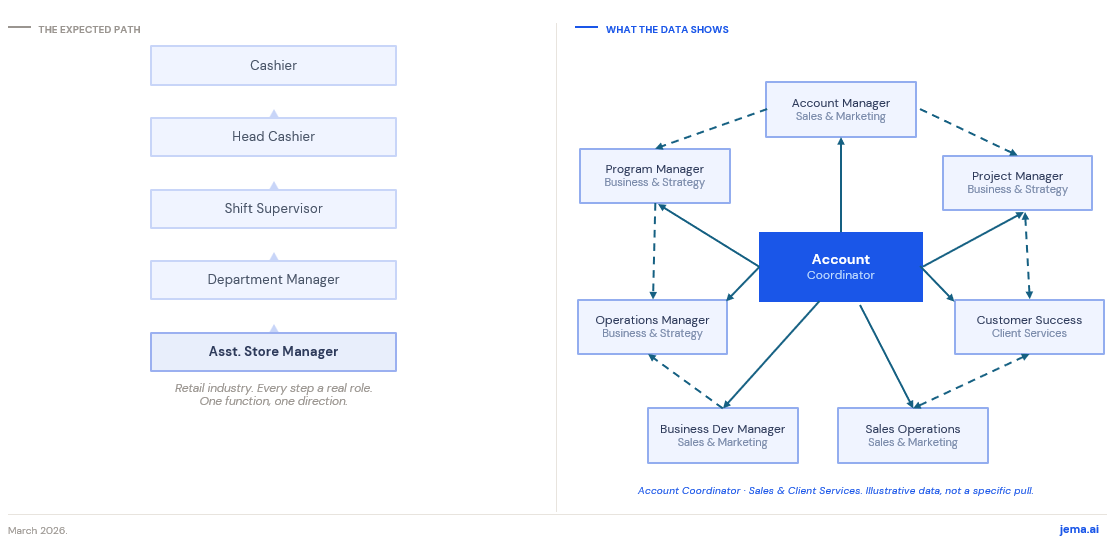
Career advice has been built around the idea of a ladder for decades. Start in an entry-level role, gain experience, move up step by step, and eventually reach senior leadership. Jema's career intelligence data, drawn from thousands of mapped roles and transitions, tells a different story. Careers often do not move up a ladder. Its very common for them to move through a network. And the vocabulary workers and employers use to describe that network is far more fragmented than most people realize.
Drawn from a comprehensive map of thousands of roles and tens of thousands of career transitions, cross-referenced against millions of job listings. More than half of all transitions cross industry lines. The average role carries nearly five alternate titles in active use across the economy.
How careers move through networks, not ladders
People tend to think of career growth as vertical: take a role, perform well, get promoted within the same function. The transition data does not always support that picture. More than half of all classified career transitions cross industry boundaries entirely. The average role points toward multiple distinct next-step destinations, and the majority of those destinations are not simply the next rung on the same ladder.
Analytical roles point toward operational leadership. Customer-facing roles point toward relationship management and strategy. Technical specialists point toward product and program leadership. These are lateral moves that expand scope and function, not promotions within a narrow track. The career network rewards range and adaptability in ways the ladder model never anticipated.
More than half of all mapped career transitions cross industry lines. The ladder model was never the map.
Careers cross industries more often than people expect
When career transition data is analyzed at scale, the cross-industry pattern is impossible to ignore. Warehouse supervisors move into supply chain operations. Customer success managers pivot into sales leadership. Analysts transition into product management. No single industry is a closed loop. The career economy is far more porous than occupational categories suggest, and the workers who navigate it best are the ones who understand that their skills translate further than their job title implies.
Cross-industry career moves are not exceptions or career pivots in the dramatic sense. They are the statistical norm. Planning a career as if you will stay within one industry may be one of the most significant mistakes the ladder model encourages.
The career destinations nobody talks about
When every career path entry across thousands of roles is aggregated by destination, a clear pattern emerges. The roles that sit at the center of the career network are not the glamorous destinations that dominate career advice. Within Jema's data, Operations Manager emerges as the single most common career destination, drawing workers in from across nearly every industry sector. Project Manager follows, notable less for raw volume than for the sheer breadth of fields it draws from. Supply chain, compliance, logistics, and facilities management round out the top destinations.
These are roles that exist at the intersection of function, people, and complexity. They appear at the center of the network because they genuinely sit there, pulling in workers from technical, analytical, customer-facing, and operational backgrounds alike. Career advice that focuses on vertical progression within a specialty systematically undervalues these convergence points.
The most arrived-at career destinations are not the ones most talked about. Operations and project leadership sit at the center of the network because they earn it.
Job title fragmentation makes the network harder to navigate
The second structural problem compounds the first. The career network is obscured by its own vocabulary. Jema's data maps thousands of canonical role titles. Those same roles carry multiple alternate titles each, producing tens of thousands of distinct title strings in active use across the economy for the same underlying roles. The typical role carries roughly five alternate titles in active use across the economy. A professional searching for a role may encounter the same position listed under several different titles depending on the employer. Workers navigating the job market without a structured view of title equivalence are solving a harder problem than they know.
Title fragmentation is not evenly distributed across fields. In Jema's data, technology and research roles show the highest fragmentation, reflecting fast-moving specialization and inconsistent employer naming conventions. Credential-linked fields like healthcare and legal show somewhat lower fragmentation, where licensing and professional standards anchor title use. Across the rest of the economy, the same role routinely operates under four or five names simultaneously.
WHAT THIS MEANS
Two compounding problems with one structural cause
The ladder model of career progression is actively misleading in two ways that reinforce each other. Career paths form a network, and the titles used to label the nodes of that network are inconsistent enough to make navigation genuinely hard without deeper intelligence underneath it.
A worker trying to move from a technical specialist role into operational leadership faces both problems at once. The right next role may exist in a different industry under a title they have never encountered. Without a structured view of how roles connect and what titles are equivalent, that move is difficult to identify and harder to execute. This is the gap Jema's career intelligence is built to close.
About the data: Insights in this report are derived from Jema's career intelligence dataset, which maps thousands of roles and their common career-path destinations across industries. Transitions in this analysis represent mapped next-step destinations by role, not observed individual job changes. The dataset is cross-referenced against millions of job listings to validate role relationships and title equivalencies.